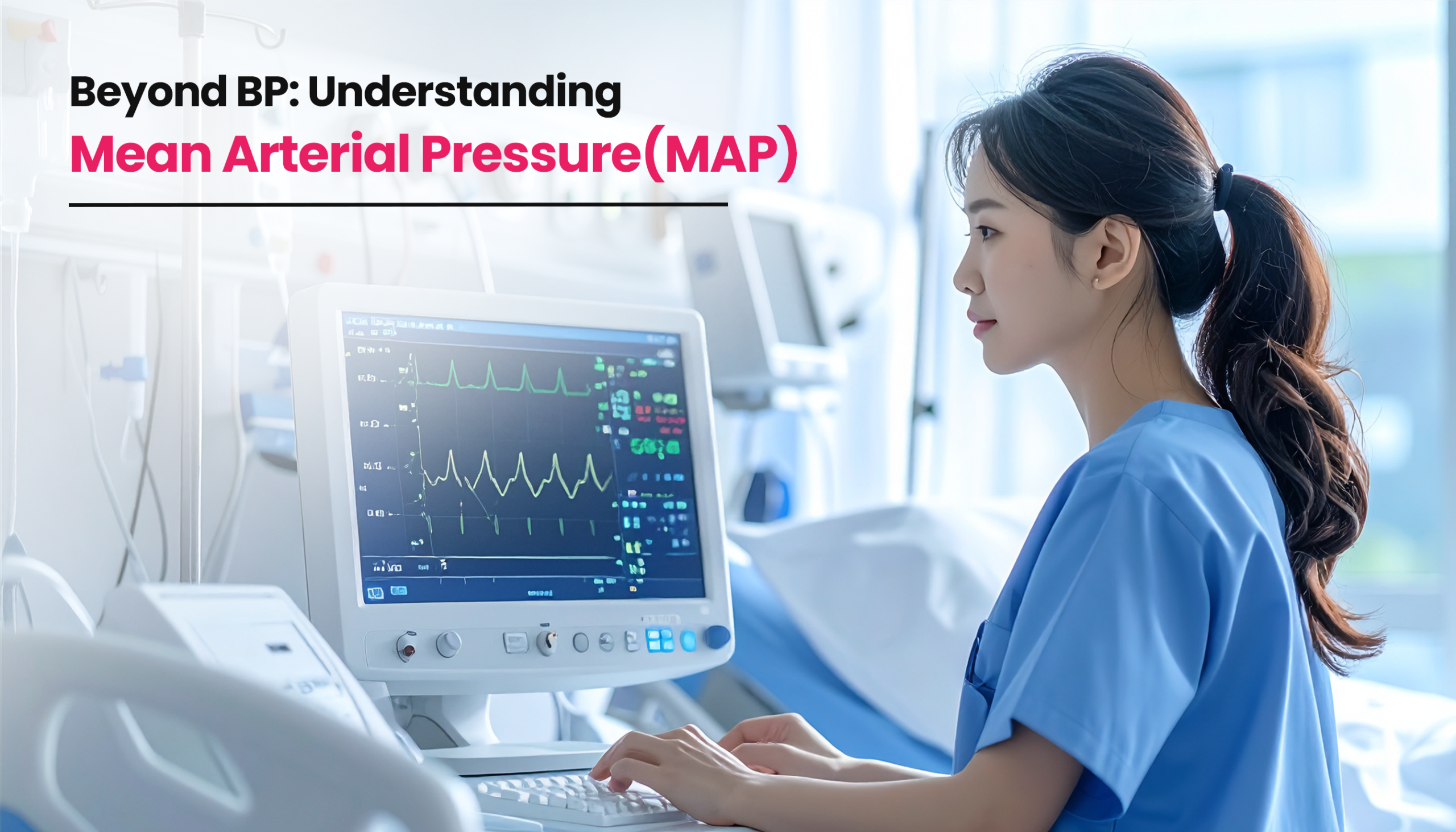
Blood pressure might look normal, but is it enough to keep patients’ organs alive? Blood pressure tells you the story, but MAP tells you the truth. MAP is not just a number, but it can mean the difference between stable perfusion and organ failure. In this guide, we will help you understand what mean arterial pressure (MAP) is, and how to calculate MAP.
But before we start, level up your nursing career with SkillGigs and become part of our travel nursing world. Explore top high-paying travel nursing contracts and get a $500 bonus once you sign a contract with SkillGigs.
What is MAP (Mean Arterial Pressure)
Mean arterial pressure is the average pressure of blood in a patient’s arteries during one complete cardiac cycle, i.e., when the heart is pumping and resting. MAP helps nurses to understand if the patients are getting enough oxygen and blood to stay alive and function properly.
How to calculate Mean Arterial pressure?
To calculate Mean Atrial Pressure, we have the MAP formula.
Systolic and Diastolic Blood Pressure
MAP = Systolic BP + (2 × Diastolic BP) ÷ 3
Mean Atrial Pressure = Systolic Blood Pressure + (2 × Diastolic Blood Pressure) ÷ 3
Example:
If Systolic BP is 90 mmHg
Diastolic BP is 60 mmHg.
Then MAP = 90 + (2× 60) ÷ 3
MAP = 210 ÷ 3 = 70 mmHg
Normal MAP is 70 – 100 mmHg, and the minimum for organ perfusion is ≥ 65 mmHg.
Alternate MAP formula using Pulse Pressure
This MAP formula highlights pulse pressure:
MAP = DBP + ⅓ (SBP − DBP)
Mean Atrial Pressure = Diastolic Blood Pressure + ⅓ (Systolic BP – Diastolic BP)
Example
SBP = 120 mmHg
DBP = 80 mmHg
First, calculate the pulse pressure that is the difference between SBP and DBP
MAP = 120 – 80 = 40
And then multiply by ⅓
31×40=13.33
Now add DBP 80 + 13.33 = 93.33
So, MAP is 93.33 mmHg.

Using heart rate and stroke volume
Another formula to calculate MAP is using heart rate and stroke volume, but it is less common.
MAP = DBP +0.33 × PP
PP stands for Pulse pressure, and it is calculated by SBP – DBP
Example:
SBP = 130 mmHg
DBP = 85 mmHg
So, PP (Pulse pressure) is 130 – 85 = 45
Applying the formula:
MAP = DBP +0.33 × PP
Multiply 0.33 by PP, which is 45 in this case
MAP = 0.33 × 45 = 14.85
Add DBP
MAP = 85 + 14.85 = 99.85
MAP = 100 mmHg (round it)
Why is MAP important in nursing?
- It is an indicator of organ perfusion, such as the kidney, heart, brain, etc.
- MAP guides nurses with critical interventions.
- It also helps nurses to determine early warning signs such as bleeding,
- MAP guides nurses with medication management.
- It prevents organ damage from low or high blood pressure.
- MAP also supports patient assessment and care planning.
What is normal vs abnormal Mean Atrial Pressure?
Normal MAP range is 65 – 100 mmHg.
Low MAP (Hypotension) is < 60–65 mmHg.
High MAP (Hypertension) is > 100–105 mmHg.
What MAP should you aim for in sepsis and shock?
Target MAP in sepsis and shock is ≥65 mmHg.
What is the difference between MAP and Blood pressure?
Blood pressure is the force of blood against the arterial walls and is written in systolic and diastolic, e.g., 110/70mmHg. Whereas MAP is the average pressure in the arteries during one cardiac cycle.
What is the normal MAP range?
The normal MAP range is 70-100 mmHg.
Less than 65mmHg is hypotension (MAP < 65 mmHg).
More than 100 mmHg indicates hypertension (MAP > 100 mmHg).
Minimum MAP needed to adequately perfuse organs is equal to or greater than 65mmHg (MAP ≥ 65 mmHg).
Conclusion
Blood pressure is the force of blood against atrial wall and is measured as systolic and diastolic, whereas MAP is the average pressure in arteries during one full cardiac cycle. Sometimes, even if the blood pressure is normal, nurses should always consider MAP to assess if the organs are truly perfused. For nurses and travel nurses, it is important to accurately calculate and interpret MAP for effective patient care.
Whether you are a nurse with 2 years of experience or a skilled travel nurse, if you want to make more money, then join SkillGigs now and become part of our travel nursing world, where you get high-paying travel nursing assignments. Not only that, but you also get a $500 bonus once you sign your first contract with SkillGigs.