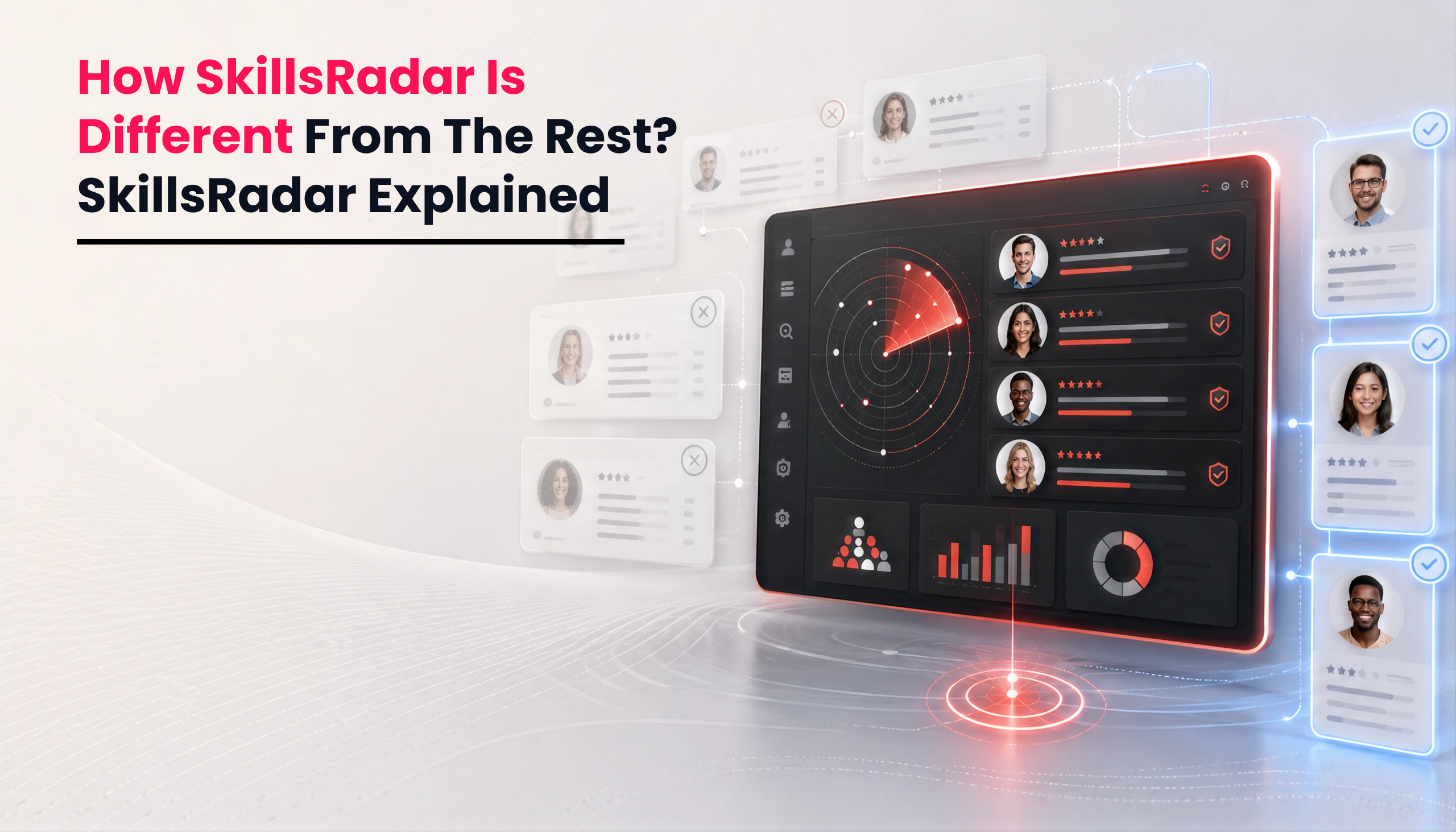
SkillRadar is a skills-verified candidate sourcing tool built for recruiters tired of reaching out to candidates who look right on paper and fall apart at the screening stage.
It gives you access to 850+ million profiles, AI-matched and evaluated through three layers of skill verification, grounded in actual demonstrated performance rather than a keyword scan of public CVs.
The idea is simple. See what a candidate can actually do before you decide to reach out. That’s what skills-verified candidate sourcing looks like in practice.
With SkillRadar, you can:
- Match candidates across 850+ million profiles using AI at scale
- See real, verified skills through a 3D Resume (structured from actual work history), a Skill Index (live market benchmark), and SkillsCreed (performance proof)
- Review full candidate capability before spending a single credit
How Most Sourcing Tools Handle Skills
Here’s the problem every recruiter knows, but most tools pretend don’t exist. Almost every sourcing platform on the market runs on the same logic.
- Scan public profiles and CVs
- Infers skills from job titles and listed tools, and
- Rank candidates based on resume keyword matching.
Its pattern recognition dressed up as ‘intelligent’ matching. And to be fair, it works (right up until the screening stage)
You build what looks like a solid shortlist. You start reaching out and get on the phone. Then the gaps appear. The candidate listed the right tools across their CV, but when you dig into the experience, it’s surface-level.
- The ‘senior project manager’ has never actually led a team.
- The ‘full-stack developer’ with five years of experience has never shipped anything beyond internal tooling.
- The travel nurse with three years of ICU experience turns out to have spent most of it in step-down, not critical care.
If you’ve been hiring for long enough, you’ve experienced this before. The profiles say the right things and check all the boxes, but the candidate doesn’t quite deliver.
This isn’t bad luck. It’s a structural problem with how CV-based sourcing works. According to SHRM, the average corporate role receives more than 250 applications, with recruiters spending 30 to 90 seconds on each resume during initial screening.
That’s hours of sorting before a single real conversation happens. And the sorting doesn’t protect you from the deeper issue. A HireRight Employment Screening study, cited by SHRM, found that 85% of employers uncovered a lie or misrepresentation on a candidate’s resume during the screening process.
Keyword matching doesn’t filter that out. It moves the problem further down your pipeline.
And the practical costs are real. Budget spent on outreach that leads nowhere, candidates who drain your pipeline before washing out, and placements you lose to someone who had better, faster information on who could actually do the job.
Most tools treat this as an acceptable cost of doing business. With SkillRadar, recruiters won’t face that problem anymore.
What “Verified Skills” Actually Mean
Claimed skills are what candidates claim they can do and verified skills are what the data shows what they have actually done
Most platforms surface inferred skills from CV data because that’s what they have, structured around job titles, dates, and keywords rather than demonstrated output.
SkillRadar is built around verified skills data instead. Every profile you see has been processed through three verification layers before it appears in your results. Here’s each layer, explained one by one.
The 3D Resume
The 3D Resume replaces the traditional CV. Instead of a formatted document built on self-reported history, it’s a structured candidate profile built from real work history and demonstrated performance. Candidates don’t fill in a template and call it done. The profile is generated from actual work signals, not personal claims.
For recruiters, this changes what you’re actually looking at. Instead of reading a document, you’re looking at a dynamic skill profile that organizes a candidate’s capabilities in a searchable, comparable format.
Two candidates who both list “data analysis” look identical in a keyword search. In a 3D Resume, you see the depth, the context, and the evidence behind that claim. It’s a candidate skills record you can search and act on, rather than a document someone else formatted to control what you see.
The Skill Index
The Skill Index is a live skills benchmark. Scores aren’t fixed when a profile is created. They’re recalibrated continuously against what the market actually needs right now.
When you’re sourcing for a DevOps engineer today, you’re not just seeing whether a candidate has relevant skills. You’re seeing how their skills compare to what’s competitive at this moment. That’s accurate candidate benchmarking. It tells you whether you’re looking at a strong hire or someone who used to be one.
SkillsCreed
SkillsCreed is the validation engine. It scores and ranks every candidate against real work outcomes and demonstrated performance, not credentials, not self-reported claims, and not keyword matches. The output is a verified capability score that sits on every SkillRadar profile.
No other sourcing tool on the market currently offers a comparable recruiter candidate verification layer. Most tools stop at matching whereas SkillsCreed confirms whether the match holds up.
How SkillRadar Compares to Other Tools You Use
Verified skills data tells you what a candidate can do before you reach out. Resume data tells you what they chose to write down. The gap between those two things is where most placements fall apart.
This is the practical difference between verified skills vs. resume data, and between skills-based hiring vs. CV hiring. One gives you confidence before you pick up the phone. The other gives you information that holds up until it doesn’t.
Let’s take a quick look at how SkillRadar fares vs some of its competitors.
SkillRadar vs. LinkedIn Recruiter
LinkedIn Recruiter is fast and familiar. It’s also built almost entirely on what candidates have chosen to write about themselves. Matching is keyword- and title-based, which means you’re surfacing candidates whose profiles were optimised for search.
The practical cost is outreach volume. Because the targeting isn’t grounded in verified data, you send more messages to get the same results. More screening calls, more drop-offs, more time before a placement closes. SkillRadar narrows that by starting with verified skills data, so the candidates you reach out to have already been filtered against what they can actually demonstrate.
SkillRadar vs. Loxo
Loxo infers skills from resume data. That means the quality of your shortlist is only as good as how honestly and accurately a candidate described themselves. If they knew the right keywords to include, they surface. If they didn’t, the right candidate can be lost in the pool of millions.
SkillRadar verifies skills before a candidate appears in your search. That’s a fundamentally different model. Your shortlist doesn’t depend on candidates writing the right things. It depends on what the data shows they’ve actually done. This results in fewer mismatches and more placements that stick.
SkillRadar vs. Juicebox (PeopleGPT)
Juicebox is built for speed and scale. It generates large candidate lists quickly using AI across a broad profile database and it’s genuinely good at that. But speed and scale on CV data still gives you unverified matches. You’re moving faster through the same quality problem.
SkillRadar combines that scale with the verified skills layer Juicebox doesn’t have. The candidates you surface have gone through SkillsCreed verification and Skill Index benchmarking. The result is fewer candidates who look strong and fall apart, and more placements where the match held because it was grounded in something real.
Get Started with SkillRadar for Free
Ready to see what the future of skilled hiring looks like? You get 25 free credits. Run your first search, review verified profiles and see exactly what a candidate can do before you spend anything.
Frequently Asked Questions
What Makes SkillRadar Different From Other Sourcing Tools?
SkillRadar verifies skills through three independent layers before any profile reaches your results. The 3D Resume, Skill Index, and SkillsCreed each add a dimension of verification that CV-based tools don’t have. You see demonstrated capability, not inferred data.
Is SkillRadar a Job Board?
No. SkillRadar is a candidate sourcing tool built for recruiters. Candidates don’t apply through it. You source them.
How Does SkillsCreed Verify Skills?
SkillsCreed scores candidates against real work outcomes and demonstrated performance. It generates a verified capability score for each profile, separate from and more rigorous than anything self-reported on a CV.
Is SkillRadar Better Than LinkedIn Recruiter?
For match quality, yes. LinkedIn Recruiter surfaces candidates based on keyword and title matching. SkillRadar surfaces candidates whose skills have been verified before they appear in your search. That difference shows up in shortlist quality, reduced screening time, and fewer drop-offs through the process.
Why Is Skills-Based Hiring Important?
Skills-based hiring evaluates what candidates can do in the real world, not what their job title implies. It reduces mismatches, cuts screening time, and produces hires that perform because the decision was grounded in demonstrated capability.