

Patients in acute care face a rapid change in their condition, but have you ever wondered how acute care nurses stay ahead in life and death situations? The secret is a precise, actionable nursing care plan that helps nurses to anticipate complications and prioritize interventions to save the patient’s life. Nursing Care Plan (NCP) is a structured approach that guides nurses through diagnosis, assessment, intervention, and evaluation. In this blog, we will discuss in detail a nursing care plan for acute pain, so let’s dive in.
Do you know that SkillGigs not only helps travel nurses get top high-paying travel nursing contracts but also giving $500 bonus if you sign your first contract. So don’t wait, sign up now, and explore top travel nursing assignments.
What is a Nursing Care Plan? (NCP)
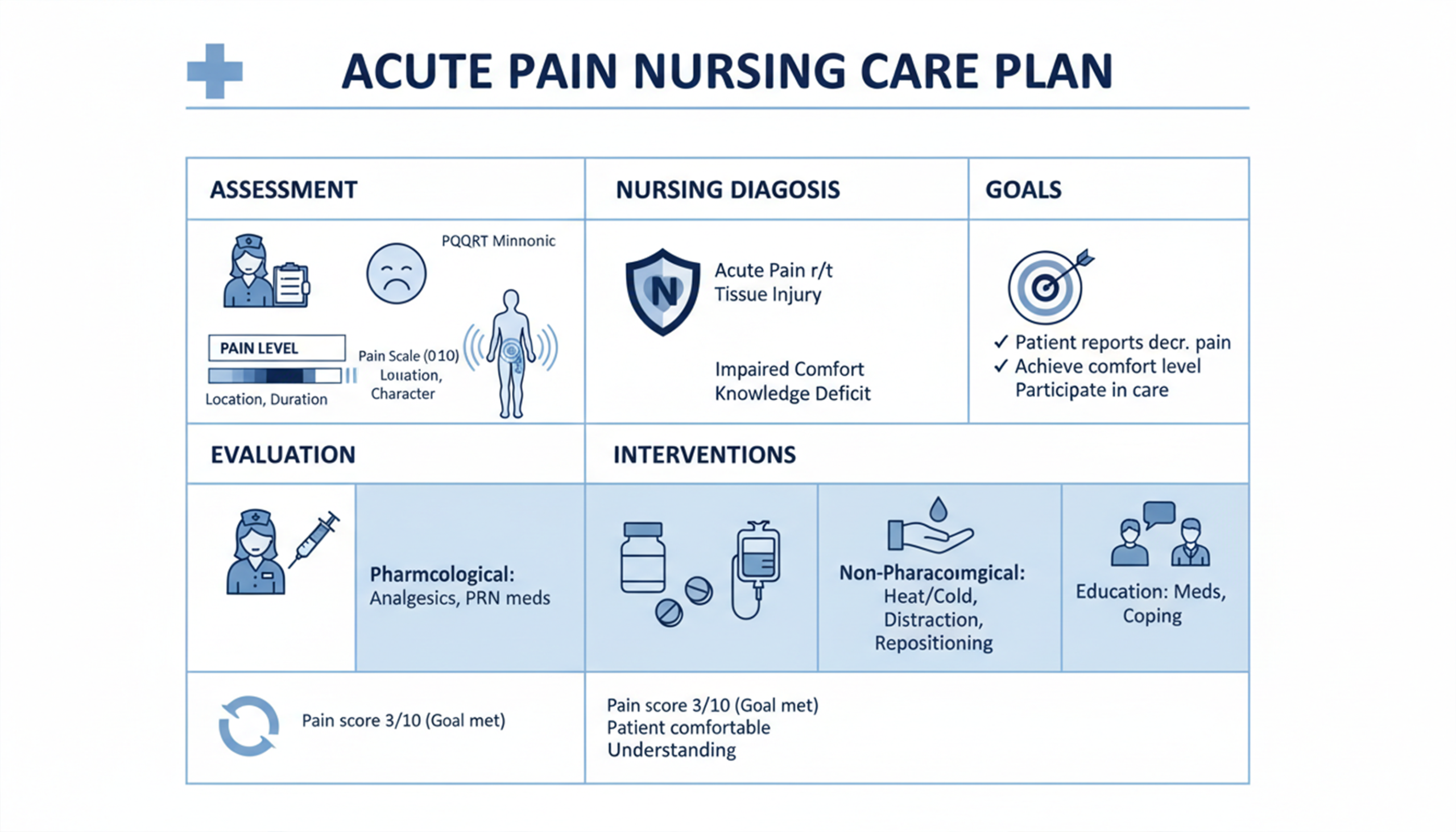
A nursing care plan (NCP) is a structured approach that helps nurses deliver safe, organized, and effective care. The key components of the nursing care plan are:
- Assessment
- Diagnosis
- Goals and outcomes
- Nursing interventions
- Evaluation
What is Acute Pain/ Pathophysiology?
Acute pain is sudden, sharp, or intense pain that indicates or serves as a warning of injury or illness. It is short-term and has a specific cause and can be resolved once treatment starts. Common causes of acute pain are:
- Surgical procedures,
- Acute illness, such as appendicitis
- Burns or fractures, etc.
Nursing care plan (NCP) for acute pain with an example
Let’s discuss the nursing care plan for acute pain in detail.
Assessment:
The first step for a nursing care plan (NCP) for acute pain is assessment. Assessment means collecting information about the patient’s physical, emotional, psychological, and social health. Use the OLDCART or PQRST method to assess the pain.
OLDCART method:
Asking about the pain:
- Onset: When did the pain start, and was it sudden or gradual?
- Location: Where is the pain?
- Duration: How long does the pain last, and is it intermittent or constant?
- Characteristics: Can you describe the pain, such as whether it is sharp, throbbing, dull, etc.
- Aggravating factors: What makes the pain worse?
- Relieving factors: What makes the pain better?
- Treatment: What have you done to relieve the pain?
Rate the pain intensity, check the history, and observe the signs.
PQRST method:
PQRST pain is also one of the pain assessment methods.
- Provocation or palliation: What is the cause of the pain, and what makes it better or worse?
- Quality: Describe the nature of pain, is it sharp, dull, burning, etc.
- Region or radiation: What is the location of pain, and is it in one place or spreading?
- Severity: Rate the pain from a scale of 1 to 10. How severe is it?
- Timing: When did the pain start, and is it intermittent or constant?
To learn more about PQRST pain, read our blog: How to Perform PQRST Pain Assessment: With Nursing Examples
Both of these methods are used to collect information about the acute pain of the patient, but the OLDCART method includes treatment history, too.
Nursing diagnosis
Nursing diagnosis is step 2 of the nursing care plan (NCP), to identify the problem (acute pain) using the NANDA-I diagnosis. NANDA-I stands for North American Nursing Diagnosis Association International and is a standardized language used by nurses and healthcare providers to describe patients’ health problems, and helps in planning, implementing, and evaluating nursing care. The components of NANDA-I are:
- Problem: What is the problem? In this case, acute pain.
- Etiology: What is the cause of the pain? For example, incisions from surgery.
- Symptoms: Evidence of the problem, such as rating pain 8/10, grimacing, etc.
Goals and outcomes
This is step 3 in the nursing care plan (NCP). Set clear SMART goals (both short and long) for pain relief.
- Specific (S): The goals should be clear and precise, such as patient reporting reduced pain or no pain after treatment.
- Measurable (M): Goals are measurable and trackable, for example, pain was 8/10 before and now it is 2/10 after medication. Use both subjective and objective measures.
- Achievable (A): Goals should be realistic and achievable, such as prescribing pain medication, etc.
- Relevant (R): The goal should be relevant; reducing pain will help in patient mobility.
- Time bound (T): There should be a deadline for the goal, for example, after giving pain medication, the pain level should decrease in 30 minutes.
Set both short-term and long-term goals.
Short-term goal: The patient will report a decrease in pain from 8/10 to 2/10 after 30 minutes of taking pain medication.
Long-term goal: Patient will be able to move and will have no pain by discharge.
Nursing interventions
Another step in the nursing care plan (NCP) is nursing interventions, which are the actions or strategies that nurses take to achieve the goals in the Nursing Care Plan (NCP). Types of nursing interventions are:
- Dependent nursing interventions (Pharmacological intervention): Actions that require a doctor’s orders, such as administering prescribed medication.
- Independent nursing interventions (non-pharmacological intervention): Actions that do not require a doctor’s order, such as breathing exercises.
- Interdependent nursing interventions (Collaborative Interventions): Actions that are carried out with the help of other healthcare workers, for example, collaborating with a dietician for a meal plan and with a physical therapist for an exercise plan.
Evaluation
This is the last step of the Nursing Care Plan (NCP), which indicates whether the goals were achieved or not.
- Ask the patient about the pain.
- Observe the patient.
- Document the results and report.
Nursing care plan for acute pain related to postoperative incision
Assessment:
- Using a numeric scale (0-10) for adults and Wong – Baker faces for children to rate the pain.
- Ask questions using the OLDCART/ PQRST method to collect data, such as where the pain is, when it started, etc.
- Collect both subjective and objective information.
Nursing diagnosis:
Rating pain 8/10 is evidence of acute pain related to the postoperative incision.
Goal:
Patient reports reduced pain levels from 8/10 to 2/10 after 1 hour of taking pain medication for acute pain due to postoperative incision.
Nursing interventions:
Administer prescribed analgesic.
Evaluation:
Patient reports 3/10 after 1 hour of taking analgesics.
What are the different types of pain?
Here are different types of pain
Based on duration:
- Acute pain: Short-term and sudden, related to surgery, injury, or illness.
- Chronic pain: Lasts more than 3-6 months, such as arthritis.
Based on source/pathophysiology:
- Neuropathic pain: Pain caused by nerve damage.
- Nociceptive pain: Pain caused by actual tissue damage.
Radicular pain: Pain caused by compression of nerve roots.
Based on pattern or experience:
- Referred pain: Pain that is felt in a different area from the source, such as during a heart attack, you feel pain in the left arm or jaw.
- Radiating pain: A type of pain that travels along the nerve path, such as sciatica pain.
Conclusion
Nursing care plan (NCP) for acute pain helps nurses to assess, diagnose, set realistic goals, implement interventions, and evaluate outcomes. A precise nursing care plan is a road map to safe, high-quality patient care.
Become a travel nurse with SkillGigs and get the opportunity to work in top healthcare facilities with premium pay. Download our app and explore travel nursing assignments that match your skills and needs. Not only that, but you get a $500 bonus once you sign up for your first contract with SkillGigs.