

Python has emerged as one of the most influential programming languages in modern software development. Whether you’re building web apps, automating routine tasks, analyzing massive datasets, or crafting intelligent AI systems, Python offers an unmatched combination of simplicity, flexibility, and power, making it a favorite among startups and enterprise teams alike. Thats why Python for software development is in demand in 2026.
In this guide, we’ll explore why Python has become indispensable in software development, its key benefits, popular frameworks and tools, real-world use cases, and how you can leverage it effectively for your next project.
What Is Python and Why It Matters
Python is an interpreted, high-level programming language designed to emphasize readability, ease of use, and developer productivity. Its clean syntax makes complex logic easier to express, and its dynamic nature enables rapid iteration, a crucial advantage in today’s fast-moving software landscape.
Unlike languages that require explicit compilation, Python is executed line-by-line at runtime, shortening the feedback loop between writing and testing code. This advantage makes it especially well-suited for rapid development, prototyping, and iterative improvement, key attributes of agile and lean software teams.
The Rise of Python in Software Development
Python’s popularity has grown steadily over the past decade. It’s no longer the “beginner’s language” it once was; today, it is widely adopted by professional engineers, data scientists, AI researchers, and enterprise architects alike.
Several industry benchmarks and language popularity indexes frequently rank Python near the top for usage, demand, and community activity, a testament to its pervasive role across domains.
Why Use Python for Software Development?
Python’s appeal in software engineering goes beyond simple syntax. Its strengths are rooted in practicality, productivity, and versatility:
1. Clean, Readable Syntax
Python’s syntax is designed to be intuitive and straightforward. Its code often reads like plain English, making it easier for developers to understand, maintain, and debug software, whether you’re a beginner or a seasoned coder.
2. Massive Ecosystem of Libraries and Frameworks
One of Python’s biggest assets is its rich ecosystem:
- Web frameworks like Django and Flask simplify backend development.
- Data tools such as Pandas and NumPy make data processing and analysis efficient.
- AI and ML libraries like TensorFlow, PyTorch, and Scikit-learn accelerate machine learning and deep learning tasks.
- Automation and scripting tools help streamline testing, deployments, and task automation.
This breadth of tools means developers can often solve problems with existing, trusted packages rather than writing everything from scratch.
3. Versatility Across Domains
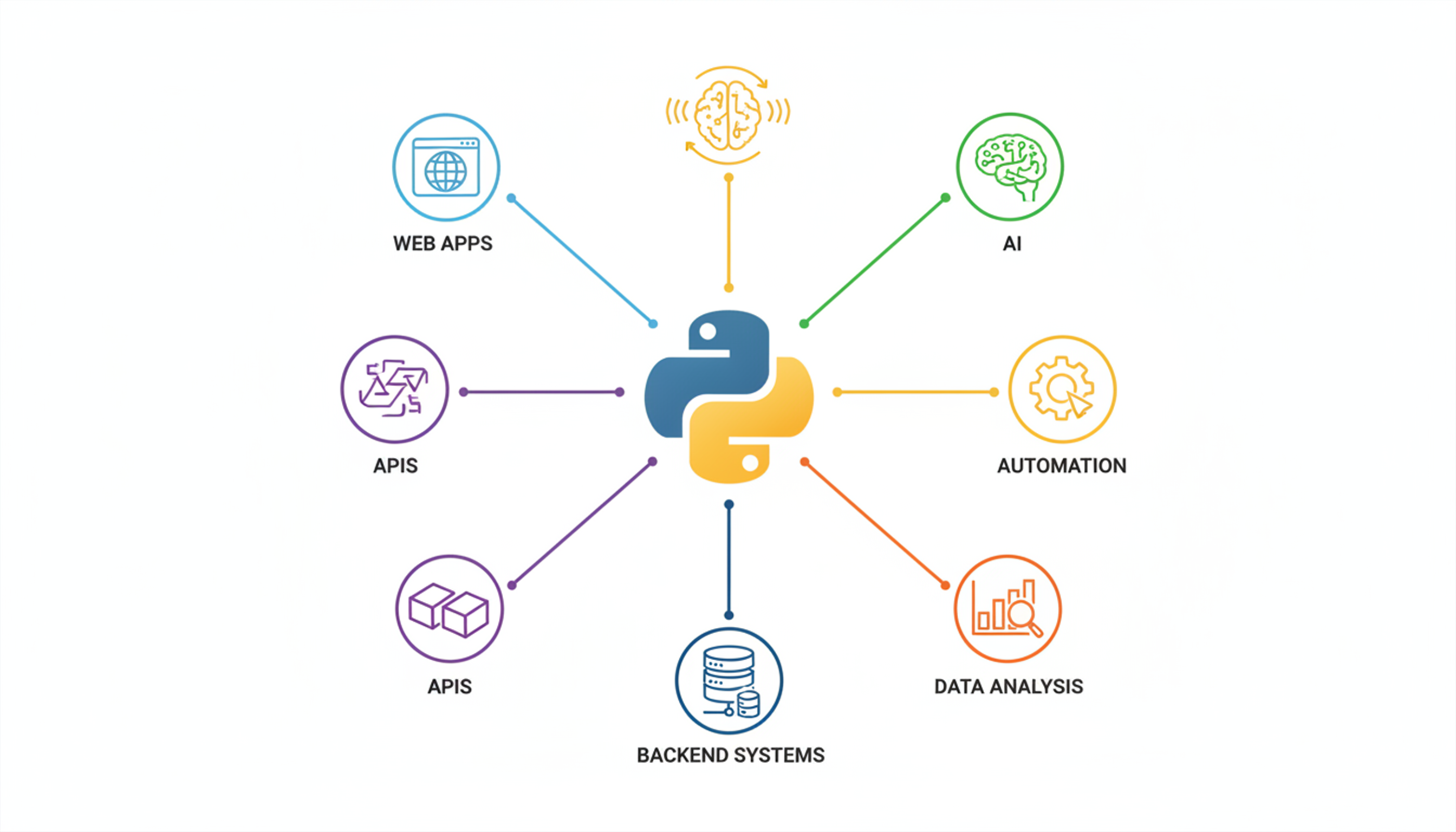
Python’s strengths extend across many areas of software engineering:
- Web and backend development
- Mobile and desktop applications
- Data science and analytics
- Artificial intelligence and machine learning
- Scripting and automation
- Scientific computing
For many engineering teams, Python serves as a common denominator that unifies different parts of the development workflow.
4. Portability and Cross-Platform Support
Python runs on all major operating systems, Windows, macOS, and Linux, without requiring significant code changes. This cross-platform flexibility makes Python a strong choice for distributed systems and multi-environment deployments.
5. Strong Developer Community and Support
Python has one of the most active open-source communities in the world. Thousands of developers contribute to libraries, frameworks, tutorials, and forums, making it easier to find solutions, learn new techniques, and stay current with best practices.
The community-driven nature of Python also means that new advancements (especially in areas like AI/ML and data analytics) are quickly integrated into the ecosystem.
Key Frameworks and Tools for Python Development
Python’s ecosystem includes specialized tools that accelerate development and reduce costs:
- Django: A full-featured framework for scalable web applications.
- Flask: A lightweight framework ideal for microservices and APIs.
- FastAPI: Designed for high-performance APIs with asynchronous support
- NumPy & Pandas: Foundational libraries for scientific and data computing.
- TensorFlow & PyTorch: Leading AI and ML frameworks with extensive support.
These frameworks not only provide ready-to-use components but also enforce good design practices, security, and scalability.
Real-World Use Cases of Python
Python’s versatility is reflected in how widely it’s used across industries:
- Web platforms: Python powers everything from startup MVPs to large-scale applications.
- Data analytics: Analysts rely on Python for data cleaning, transformation, and visualization.
- Artificial intelligence: AI researchers and developers build complex models with Python libraries.
- Automation: Python scripts streamline repetitive workflows and orchestrate DevOps tasks.
Major companies across tech, finance, healthcare, and entertainment use Python in their technology stacks, a testament to its flexibility and performance.
Starting with Python Development
If you’re new to software engineering, Python is an excellent language to begin with due to its clarity and rich learning resources. Even experienced developers find Python valuable for rapid prototyping, experimentation, and production-level code.
To start:
- Set up a development environment with tools like PyCharm or VS Code.
- Learn Python basics through interactive tutorials.
- Explore frameworks like Django or Flask for web apps.
- Practice building small projects to apply what you’ve learned.
- This approach helps you build competence and confidence as you grow as a developer.
Conclusion
Python has rightfully earned its place as a cornerstone of modern software development. Its simplicity, versatility, extensive libraries, and strong community support make it a go-to choice for developers across industries and project types. Whether you’re building web apps, data science pipelines, or intelligent AI systems, Python provides the flexibility and power to get the job done and keep your codebase maintainable and scalable well into the future.