
Healthcare staffing leaders are facing a structural shift. Rising vacancy rates, escalating agency costs, and prolonged time-to-fill have forced hospitals to rethink how they source nursing talent. For decades, nurse recruitment agencies were the default solution. Today, healthcare organizations are increasingly evaluating nursing agency alternatives, including talent marketplaces built for direct sourcing and workforce ownership.
The question is no longer whether to change, but which model actually fits your facility’s staffing reality.
Understanding the Two Models
Before choosing a direction, it’s important to understand how traditional staffing agencies and modern healthcare talent marketplaces fundamentally differ.
Traditional Nurse Recruitment Agencies
Agency models focus on sourcing, placing, and managing nurses on behalf of healthcare facilities. Control, pricing, and talent relationships largely remain with the agency.
Talent Marketplaces
A healthcare talent marketplace enables hospitals to directly source, engage, and redeploy contingent clinicians through a platform the facility controls. The marketplace becomes a long-term staffing asset—not a transactional service.
When Traditional Nurse Recruitment Agencies Still Make Sense
Agencies are not obsolete. In specific scenarios, they can still play a role.
Agencies may be appropriate when:
- Highly specialized roles require national recruitment
- A one-off emergency occurs without an existing talent pool
- The facility has no internal recruiting infrastructure
- Immediate coverage is needed within 24–48 hours
In these cases, speed and reach outweigh long-term cost efficiency.
When a Talent Marketplace Clearly Wins
For many healthcare systems, especially those managing recurring staffing challenges, the talent marketplace model delivers stronger outcomes.
Talent marketplaces excel when:
- Contingent staffing needs are ongoing (per diem, seasonal surges)
- Annual agency spend exceeds $500,000
- Existing ATS databases can be reactivated
- Leadership is focused on reducing long-term staffing costs
- Hospitals want ownership of clinician relationships
This is where healthcare direct sourcing shifts staffing from reactive to strategic.
Why Talent Ownership Changes Everything
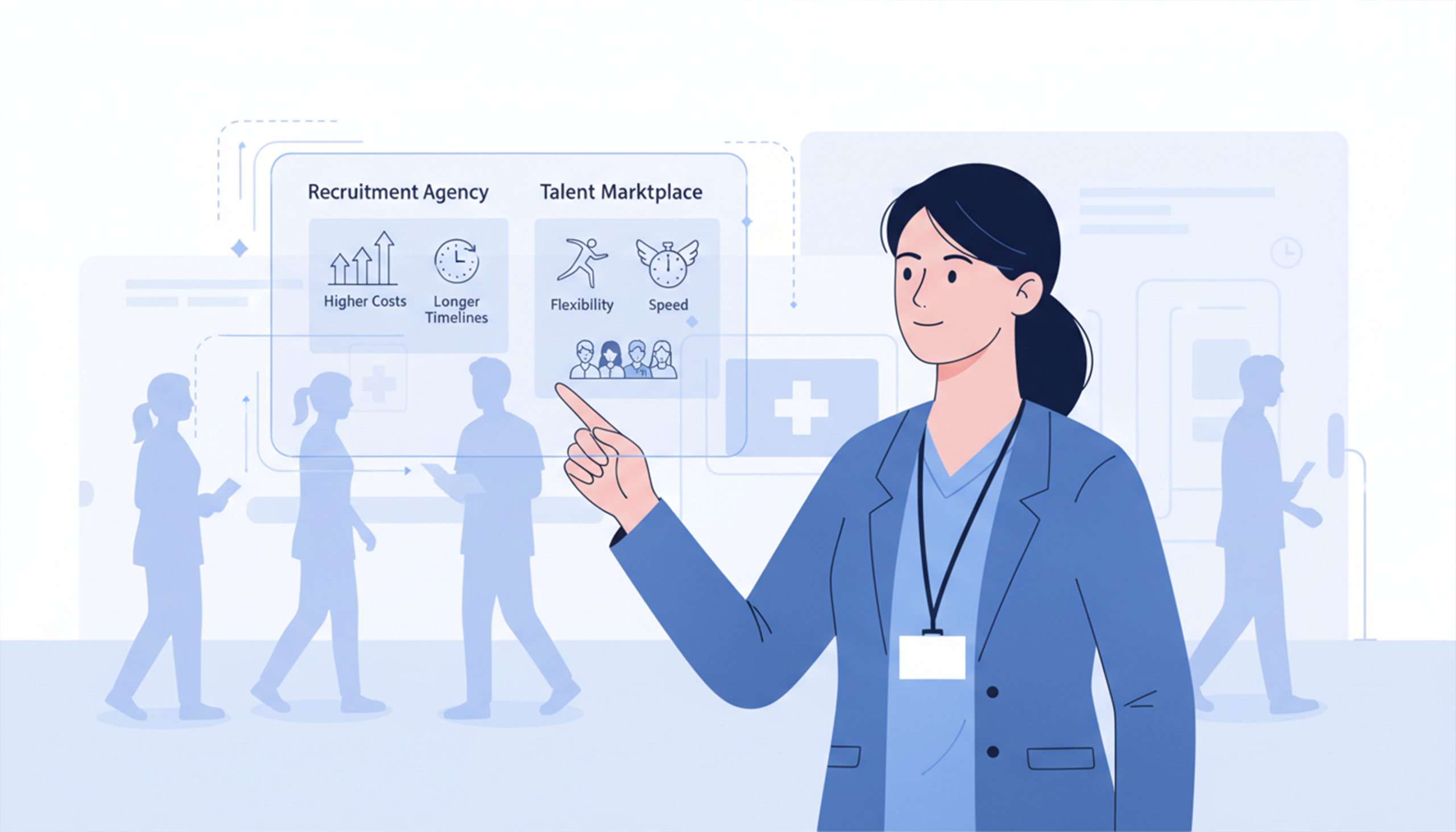
Agency models reset relationships after every assignment. Once the contract ends, the talent disappears.
Talent marketplaces do the opposite:
- Clinicians remain in the hospital’s private talent pool
- High performers are redeployed instead of replaced
- Workforce data improves with every assignment
Over time, this creates stability, not just coverage.
A Practical Hybrid Strategy
Many healthcare systems don’t choose either/or. They choose both, with intention.
A common approach:
- Use a talent marketplace as the primary staffing channel
- Retain 1–2 agencies for niche, overflow, or emergency needs
This hybrid model reduces agency dependency without eliminating flexibility.
How to Decide: A Simple Decision Framework
Healthcare leaders evaluating contingent workforce models should ask:
- What is our annual contingent labor spend?
- How long does it take us to fill nursing vacancies today?
- How much agency markup are we absorbing?
- Do we own any part of our contingent talent pipeline?
- Are staffing costs rising faster than patient volume?
If these questions expose recurring inefficiencies, it’s time to reconsider the model—not just the vendor.
Talent Marketplace vs. Legacy VMS Programs
Unlike traditional VMS solutions tied to agency ecosystems, modern healthcare talent marketplaces are built for ownership, transparency, and speed.
They replace:
- Vendor dependency
- Markup opacity
- Fragmented staffing workflows
With:
- Direct sourcing
- Transparent bidding
- Performance-driven redeployment
This positions marketplaces as a true alternative, not just another tool.
Choosing the Right Model for the Future
The nurse staffing challenge isn’t going away. The organizations that adapt will be the ones that shift from renting labor to building workforce infrastructure.
Whether your facility stays with agencies, adopts a talent marketplace, or implements a hybrid model, the decision should be intentional, data-driven, and aligned with long-term cost control.
Ready to Evaluate Your Best Path Forward?
Every hospital’s staffing reality is different.
Get a custom workforce strategy assessment to evaluate:
- Your current agency spend
- Potential cost savings through direct sourcing
- The right mix of marketplace and agency support
A short consultation can clarify which staffing model aligns with your clinical, financial, and operational goals.