
When it comes to building software or scaling your tech team, one decision can shape everything including cost, speed, quality, and long-term growth which is in-house vs outsourcing. Should you build an in-house team or should you outsourcing development?
There’s no one-size-fits-all answer. The right choice depends on your goals, budget, timeline, and how much control you need. But understanding the real pros and cons of each model can help you make a smarter decision.
What Is In-House Development?
In-house development means building your own internal team hiring developers, managing them, and handling everything from infrastructure to delivery within your organization.
This approach gives you full ownership of the process, but it also comes with significant responsibility. Companies must invest in hiring, training, tools, and long-term retention.
What Is Outsourcing?
Outsourcing, on the other hand, means partnering with an external company or team to handle development. This can be done locally, nearshore or offshore depending on your needs.
Instead of building everything internally, businesses leverage external expertise to deliver projects faster and often more cost-effectively.
Pros of In-House Development
In-house teams are often preferred when control and long-term alignment are critical. One of the biggest advantages is complete control. You can monitor progress in real time, adjust priorities instantly, and ensure everything aligns with your business goals.
Another key benefit is deeper collaboration. Since your team works closely together every day, communication is faster and more natural, leading to better problem-solving and innovation.
You also retain strong ownership of your intellectual property, which is especially important in industries with strict compliance or security requirements.
Key advantages include:
- Full control over development and decision-making
- Strong team collaboration and culture alignment
- Better protection of intellectual property
- Deep institutional knowledge over time
Cons of In-House Development
While in-house teams offer control, they come at a cost literally and operationally. Hiring skilled developers is expensive, and the costs don’t stop at salaries. Companies must also cover benefits, infrastructure, and ongoing training.
Another challenge is limited access to talent. Many businesses struggle to find the right expertise locally, especially for niche or emerging technologies. Scaling is also slow. Hiring takes time, and adjusting team size based on project demand isn’t always practical.
In simple terms, in-house development is powerful but not very flexible.
Pros of Outsourcing
Outsourcing has become increasingly popular because it solves many of the challenges that come with in-house teams.
The biggest advantage is cost efficiency. Companies can reduce expenses by working with global talent without paying full-time salaries, benefits, or infrastructure costs.
It also gives access to a much wider talent pool. Instead of being limited to local candidates, businesses can work with highly specialized experts from around the world.
Another major benefit is scalability. Outsourced teams can be expanded or reduced quickly based on project needs, making it ideal for fast-moving businesses.
Key advantages include:
- Lower operational and hiring costs
- Access to global, specialized talent
- Faster project execution
- Easy scalability and flexibility
Cons of Outsourcing
Despite its advantages, outsourcing isn’t without risks. The biggest drawback is reduced control. Since the team operates externally, it can be harder to monitor progress and enforce standards.
Communication can also become a challenge, especially when working across different time zones or cultures. Without strong processes, delays and misunderstandings can occur.
There are also concerns around data security and intellectual property, as external teams require access to sensitive systems.
In short, outsourcing works best when managed properly but it requires structure and trust.
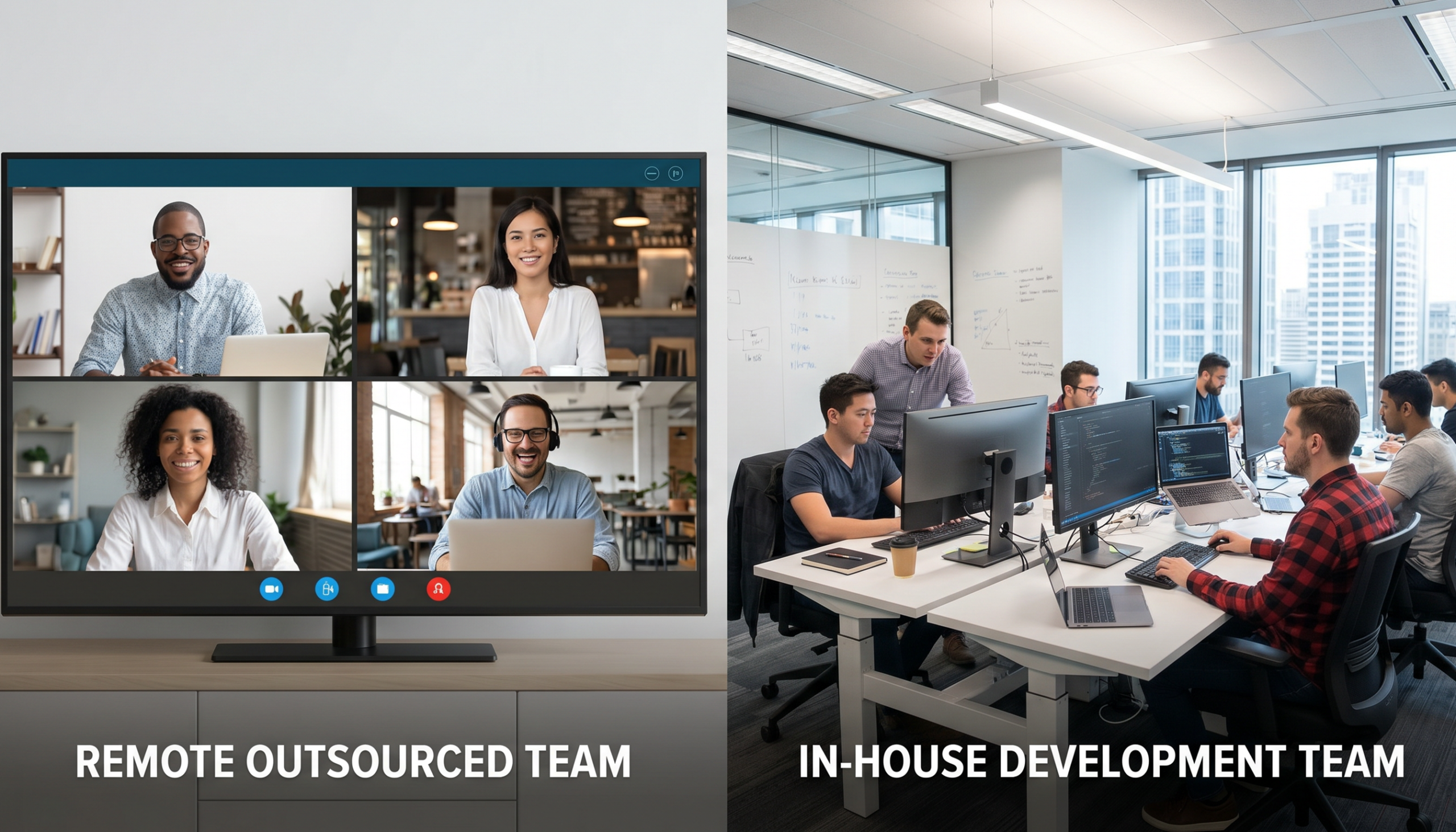
In-House vs Outsourcing: Key Differences
Instead of thinking of this as a simple choice, it’s better to understand how they compare across key factors.
- Control: In-house offers full control; outsourcing requires structured oversight
- Cost: Outsourcing is generally more affordable; in-house has higher fixed costs
- Talent Access: Outsourcing provides global reach; in-house is limited locally
- Scalability: Outsourcing is flexible; in-house scaling is slower
- Speed: Outsourcing enables faster onboarding; in-house hiring takes time
Many companies today don’t choose one over the other, they combine both.
The Hybrid Approach (What Smart Companies Are Doing)
Modern businesses are increasingly adopting a hybrid model.
They keep core functions like product strategy and architecture in-house, while outsourcing specific tasks or projects.
This approach offers the best of both worlds:
- Control where it matters most
- Flexibility where it’s needed
- Cost efficiency without sacrificing quality
It’s not about choosing sides, it’s about optimizing your resources.
How to Decide What’s Right for You
The decision ultimately depends on your business context.
Choose in-house development if:
- You’re building a long-term, complex product
- Security and compliance are critical
- You need deep integration across teams
Choose outsourcing if:
- You need to move fast
- You lack specific technical expertise
- You want to reduce costs and scale quickly
If you’re unsure, start small. Test outsourcing with a project, or build a lean internal team and expand gradually.
Final Thoughts
The debate between in-house vs outsourcing isn’t about which is better it’s about what works best for your business. In-house teams give you control, stability, and long-term value. Outsourcing gives you speed, flexibility, and access to global talent.
The real advantage comes when you understand how to use both strategically.
Because in today’s fast-moving tech landscape, the companies that win aren’t the ones that choose one model they’re the ones that adapt intelligently.