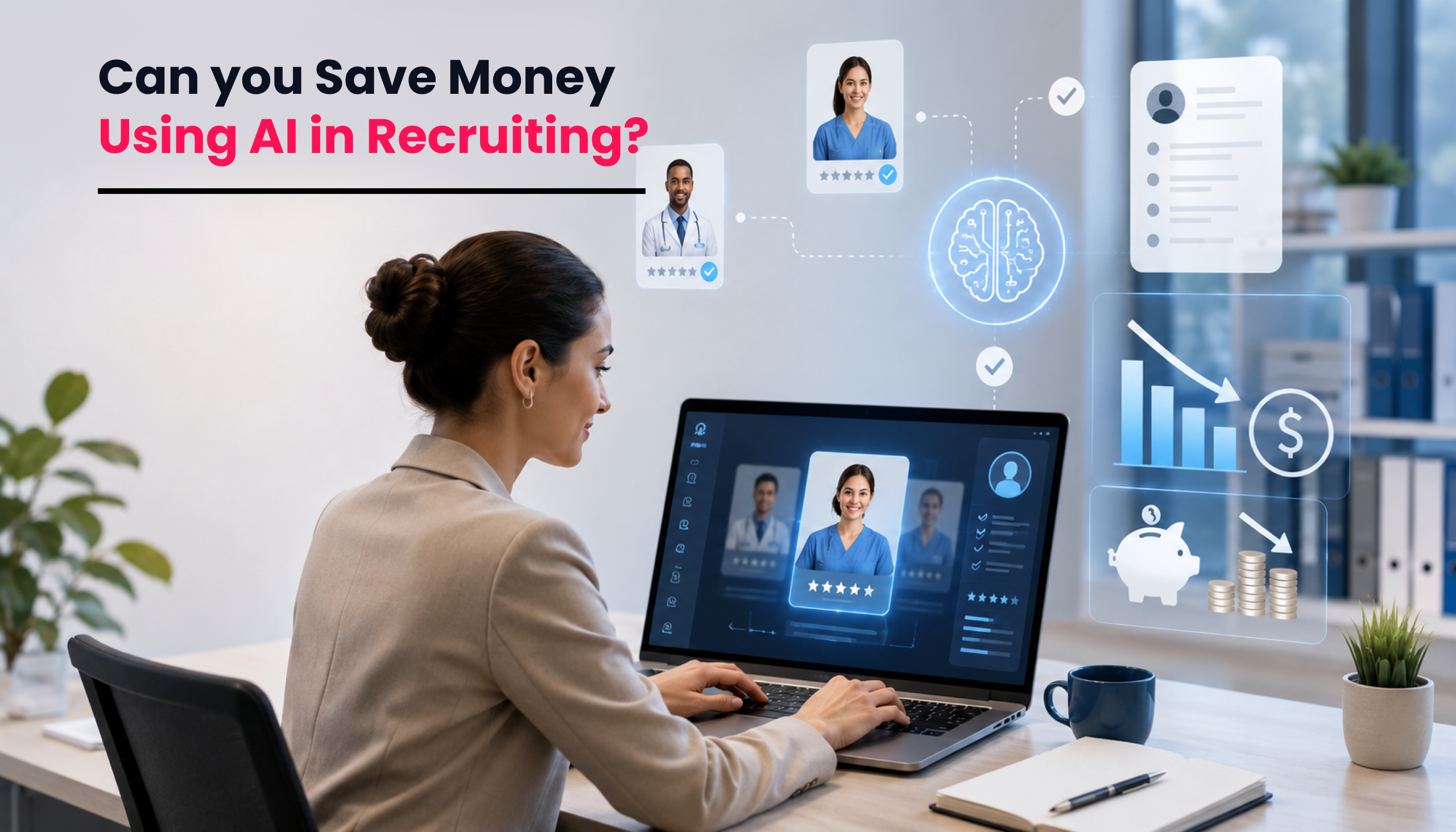
Recruiters and TA teams face constant pressure to do more with less. Fewer resources, tighter deadlines, and higher hiring standards. The good news is that AI is delivering real savings across sourcing, screening, scheduling, and retention.
And these savings don’t come from removing the recruiter. They come from removing the slow, manual work around them.
This blog breaks down how recruiters and headhunters are using AI to cut recruiting costs.
How to Use Artificial Intelligence for Recruiting Top Talent
AI tools and AI powered systems have changed how recruiters and headhunters operate throughout the hiring process. On the sourcing side, AI can prefilter job boards, networking sites and talent databases to deliver relevant leads much faster than a human could manage manually.
At the screening stage, AI powered platforms can grade and rank candidates against role requirements before a human even opens a resume. At the scheduling stage, AI removes the coordination overhead that eats hours every week. In the retention stage, some platforms now flag attrition risk during the hiring process, catching the wrong hire before an offer goes out.
This automation handles repetitive, low judgment tasks such as sorting resumes, coordinating calendars, and flagging early risk signals. That frees the recruiter to focus on judgment, relationship building and candidate experience, the parts of the job that actually require a human.
Is it Ethical to Use AI for Recruiting?
Yes, using AI in recruiting is ethical, and avoiding it altogether carries its own risk of error and inconsistency.
Using AI for recruiting doesn’t mean cutting corners or bypassing a fair process. Most AI tools are designed to minimize bias rather than introduce it. AI can limit the influence of reviewer mood or unconscious preference by scoring candidates against set criteria, which can make early stage screening more consistent than a fully manual approach.
That said, real ethical issues in AI recruitment do exist, but are specific. They center on tools that skip human review of final hiring decisions, or that are trained on historical data carrying old inequities forward. Mitigating this comes down to human-in-the-loop design, keeping a person accountable for every final call.
Consider this: the number of HR professionals using AI to tackle HR tasks rose from 26% in 2024 to 43% in 2026, with recruiting being the most prevalent use case (SHRM).
Whatever your stance on the ethics of using AI in recruiting, your competitors are already using it to find candidates faster, narrow shortlists more efficiently, and reach passive candidates before anyone else does.
Where the Real Savings Come From (How AI Actually Cuts Recruiting Costs)
There are four mechanisms behind the cost argument for AI in recruiting. Understanding each one separately helps you see where the savings actually land and which tools move which dial.
Automating and Scaling Sourcing
One of the biggest expenses in recruiting is relying on outside agencies. If a role cannot be filled from within the company or a fast-sourcing process, the next step is to go through an agency, and an agency can charge 15–25% of the first year’s salary.
AI powered sourcing tools reduce that reliance. They automatically sift through job boards, professional networks, and talent databases to surface matching candidates, cutting out hours of manual searching.
Most importantly, AI can reach passive candidates before competitors do. A passive candidate isn’t actively job hunting, but could be open to the right opportunity if it comes along.
Reaching them first changes the competitive dynamic. Recruiters with strong AI sourcing tools are building conversations earlier in the pipeline, rather than competing for the same pool of active applicants.
Resume Parsing
Reviewing resumes manually is one of the most time-consuming and inconsistent tasks a recruiter can do. Two reviewers with the same 200-resume stack will shortlist different people, often for reasons that have nothing to do with the role requirements.
This is eliminated with AI-powered resume parsing. The system can read and rank candidates against required skills in seconds, not hours, and applies the criteria to all applications. A 2024 Workable survey showed that 89.6% of respondents that leverage AI for hiring claimed they saved 85.3% of the time and 77.9% of the cost.
That time saved in resume review translates directly into lower cost per applicant and more recruiter time spent on higher value work.
Smarter Job Ad Targeting
AI job ad targeting solves that. Instead of posting everywhere and hoping, AI studies past results, including which platforms, audiences, and wording produced the highest hire rate for similar roles, and targets spend accordingly.
This produces fewer applicants, but stronger ones. Screening time drops. Cost per applicant drops. The pipeline is stronger before the recruiter ever touches it.
Streamlining Interview Logistics
Interview scheduling and post interview review are two of the biggest hidden time costs in recruiting.
Automated scheduling removes the back-and-forth email chains that can add several days to a hiring process. Candidates pick available times directly from the recruiter’s live calendar; confirmations go out automatically, and the hiring team gets notified without manual coordination. That saved time compresses time to fill directly, which matters because every day a role sits open carries a real productivity cost.
Interview intelligence tools transcribe and summarize calls in real time, capturing key points without requiring the recruiter to take notes during the conversation. Those summaries are shareable with the hiring team immediately, so decisions happen faster and with better information behind them.
Reactivating the Talent Already in Your Database
Most companies are sitting on a resource they’ve never fully used. Years of past applicants, including people who cleared a phone screen, passed a background check, or completed an assignment, sit dormant in the ATS.
Some of those candidates got passed over because the timing wasn’t right. Some left a role and are available again now. Others are currently working in a different department within the same organization, with exactly the skills an open role needs.
AI can surface all of this automatically. Talent reactivation tools filter the existing database and highlight candidates who meet the job requirements, ranking results by skill match rather than running a cold search across the entire pool. A candidate who was prescreened a year ago and is available again is a meaningfully cheaper hire than one sourced cold.
The credentialing is already done, the relationship already exists, and the time to hire is shorter. This is even more significant for internal candidates. A verified employee who fills a role in another department comes with no referral cost, no agency fee, and a proven track record.
Benefits of Using AI in Recruitment
- Faster time-to-fill: Automated sourcing, parsing and scheduling compress every stage of the hiring funnel, reducing average time-to-fill by 40–60% at organizations using AI at scale.
- Lower cost-per-hire: Less manual screen time, less agency dependency and more targeted job ad spend all reduce what you pay to make a hire.
- Better candidate quality signals: AI tools that verify skills or score candidates against predefined criteria surface stronger shortlists than keyword matching or manual resume review alone.
- Reduced recruiter admin burden: AI saves recruiters time daily with tasks such as reviewing resumes, preparing resumes, scheduling interviews, and evaluating metrics.
- More predictable hiring costs: AI removes many of the unpredictable spikes (an agency emergency fee, a prolonged search) by creating a more consistent and measurable process from the start.
- Improved retention signals: Some AI platforms now identify attrition risk during the hiring process itself, using historical performance data to flag candidates less likely to stay in the role long-term.
- Consistency across reviewers: AI scores all candidates uniformly, which helps to avoid the inconsistent scores that can result from multiple human reviewers and different standards.
How to Choose the Right AI Recruiting Tool
Not every tool that calls itself AI is worth paying for. The market has real solutions and a lot of noise, and two recruiters using the same tool will get different results depending on how well it’s set up and used. Use the following checklist before committing to any platform:
- Verified skills data vs. inferred data: Does the tool validate skills through actual work history and demonstrated performance, or does it infer them from resume keywords? Keyword matching is fast, but it’s not verification. A candidate who listed “project management” on a resume and a candidate whose project management skills have been scored against real outcomes are not equivalent.
- Pricing model: Is it free-to-search with credits on contact reveal, seat-based or credit-based? For a solo recruiter or small firm watching margin carefully, a seat-based model at $150–$200/month per user adds fast. A free-to-search, pay-on-reveal structure means you only spend money when you find someone worth reaching.
- Setup time: Can you get value in the first session, or does it require weeks of configuration and training before it produces results? Tools that need long onboarding cycles are a hidden cost. Ask for a trial that lets you test the actual sourcing output before committing.
- Transparency: Can the vendor explain in plain language how the matching or scoring actually works? If they can’t, walk away. A tool you can’t understand is a tool you can’t audit and for a headhunter or skills-verified sourcing environment, explainability matters. The recurring complaint about AI recruiting tools is that they burn through budget or credits without delivering proportionate results.
How Top Companies Are Using AI for Recruitment (Case Studies)
AI is revolutionizing hiring by reducing time-to-fill, reducing cost per hire, and improving the quality of hire. Many industry leaders are resorting to AI to make their hiring process efficient, and we are going to discuss some of them below
Unilever
Unilever was processing close to 1.8 million job applications per year through a mostly manual system. Paper-based reviews, phone screens, and in-person assessments that couldn’t scale fairly or efficiently.
In 18 months, Unilever partnered with HireVue and Pymetrics to create an AI enhanced screening process using gamified neuroscience assessments and video interview analysis and saved more than 50,000 hours of candidate interviews in the process, reduced annual recruitment spend by £1 million and time-to-hire by 75%. They also experienced 16% improvement in retention rate. Most importantly, the final decision was still in the hands of human recruiters.
Google uses its in-house AI-powered recruitment tools to scan candidates’ resumes and performance. AI ranks candidates based on the probability of success in the role, ensuring a more objective hiring process. This reduces human bias and increases the accuracy of talent selection.
According to the report, AI-based recruitment increased the probability of hiring the right candidate that fits in their culture by 30% and reduced the manual screening time by 50%.
Hilton Hotels
Hilton works with a wide range of client needs including hiring in high volumes, with a particular focus on customer-facing jobs that have an impact on customer experience. They rolled out AI technologies such as video assessment platforms and chatbots to conduct automated screening of candidates at scale and experienced a 90% reduction in replacement rates for unfilled positions.
The chatbot manages first-steps candidate interaction, scheduling, and FAQs leaving HR to concentrate on the final stages of interviewing and providing management instead of coordination.
Where AI Falls Short (and Why the Human Touch Still Wins Placements)
AI continues to become more sophisticated and – as a consequence – also makes recruitment both effective and efficient, but there are some things that still need oversight. This doesn’t mean that AI is incapable of doing those things, but it needs the human brain to make the final call and personalize the process for the desired outcomes.
Let’s discuss such cases.
A Lot of AI Recruiting Tools Are Just Noise
The term “AI recruiting tool” is used for anything from true AI-powered sourcing platforms to a simple keyword filter with a marketing overhaul. Tools that burn budget without delivering tangible results are a real and common problem.
Two recruiters looking at the same tool could see completely different results based on how the tool is set up, how it’s applied, and if the data quality is suitable for the use case. AI is a multiplier; It speeds up a good process and speeds up a bad one just as fast.
AI Should Never Make the Final Call
Human-in-the-loop design is NOT a limitation of AI. It is the right design principle. The use of AI to screen and shortlist should be supported. It should bring the candidates up to the surface, evaluate them and narrow down the funnel. However, the ethical dilemma and legal exposure of rejecting applicants without people checking it is a serious matter.
A federal court allowed a discrimination lawsuit against Workday’s AI screening tools to proceed as a nationwide class action in 2025, with the EEOC filing a brief in support signaling that algorithmic rejection without human oversight is a serious civil rights issue under review. The principle is simple: AI should narrow the field, not close the door.
Authentic Outreach Still Outperforms Automated Outreach
Generic AI-generated messages to passive candidates consistently underperform personalized ones. Recruiters who reference specific signals in their outreach, a recent project, a publication, a role change, get noticeably better response rates than those sending templated sequences. Fewer wasted outreach cycles is a direct cost saving in itself.
AI can draft the message and find the candidate, but identifying the signal that makes a message worth reading still takes a person. The best use of AI in outreach is speeding up the work, not replacing the judgment behind it.
Conclusion
The savings from AI in recruiting are real, and they come from making the process smarter and faster rather than removing the recruiter. Sourcing, screening, scheduling, and retention all have genuine AI-driven efficiencies available. The tools worth paying for are the ones that show their work, verify what they claim to verify, and keep a person making the final call.
When deciding where to start, look for platforms that combine skills verification with matching algorithms that clearly explain why a candidate was surfaced, not just that they were.
SkillGigs operates on that same principle. Every sourcing decision, internal mobility match, and contractor placement runs on the same verified skill standard, so the reasoning behind a recommendation is visible rather than hidden. That’s what separates a tool worth trusting from one you’re just hoping works.
Not ready to fully commit just yet? Get started with our SkillRadar tool for free. It helps you search and source talent from a pool of more than 800 million profiles globally.
Frequently Asked Questions
What Is an Example of AI in the Recruitment Process?
Automation of resume parsing and scoring by AI, which ranks and scores resumes without relying on a human recruiter to do so. Other examples include AI sourcing tools that identify passive candidates, automated scheduling systems and video interview platforms that analyze candidate responses and flag key moments for human review.
What is ATS vs. CRM?
An ATS handles the job posting, applications, candidate status and hiring process. It is the place where candidates reside after applying. A CRM (Candidate Relationship Management system) is used for cultivating and sustaining relationships with candidates prior to the application.
How Can Recruiters Use AI Without Losing Candidate Trust?
It’s all about transparency. Research found 67% of candidates are comfortable with AI screening as long as a human makes the final call. Tell candidates when AI is being used in the process, ensure human review happens before any rejection and choose tools that use objective, role-relevant criteria rather than opaque scoring models.