
Supply chains are the backbone of modern business. Whether companies manufacture products, deliver services, or operate digital platforms, their ability to plan, source, produce, and deliver efficiently determines operational success. However, supply chains are complex systems with multiple moving parts, suppliers, manufacturers, logistics partners, and customers. Managing these systems without a structured framework like SCOR Model can lead to inefficiencies, delays, and rising operational costs.
The Supply Chain Operations Reference (SCOR) model was developed to help organizations evaluate and improve supply chain performance using a standardized framework. It provides a consistent way to measure efficiency, identify gaps, and implement best practices across industries.
What Is the SCOR Model?
The SCOR (Supply Chain Operations Reference) model is a process framework used to analyze, measure, and optimize supply chain performance.
It helps organizations:
- Standardize supply chain processes
- Measure operational performance
- Identify inefficiencies and improvement opportunities
Align supply chain strategy with business goals. The framework was originally developed in 1996 by consulting firm PRTM and later endorsed by the Supply-Chain Council, which is now part of the Association for Supply Chain Management (ASCM).
Today, the SCOR model is widely used across industries to evaluate the maturity and effectiveness of supply chain operations.
The Six Core Processes of the SCOR Model
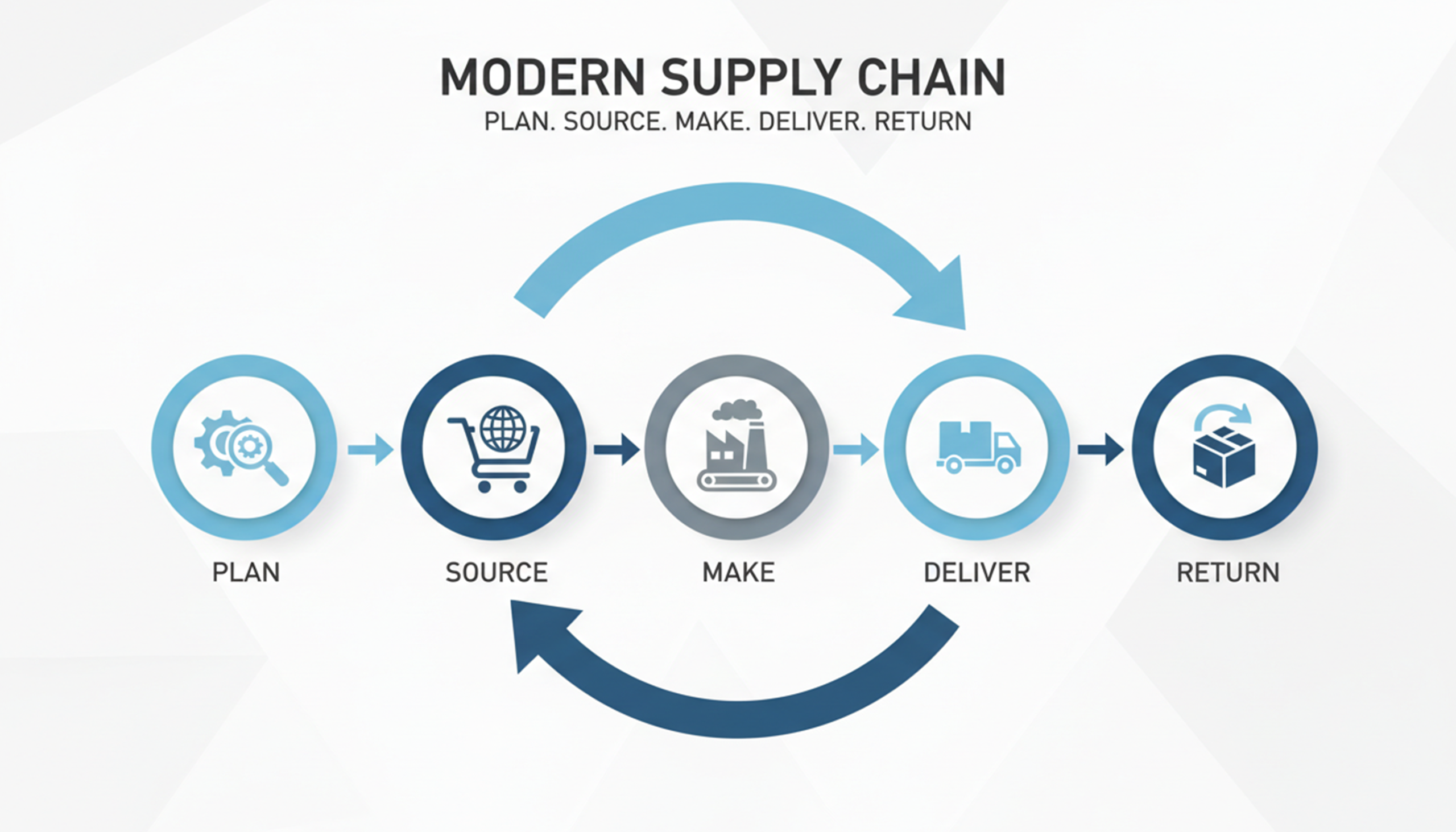
At its core, the SCOR framework organizes supply chain management into six major processes that cover the entire lifecycle of delivering products or services.
1. Plan
The planning phase focuses on designing supply chain strategies that align with business objectives.
This includes:
- Demand forecasting
- Resource allocation
- Inventory planning
- Supply chain network design
Effective planning ensures that supply chain operations can meet market demand while controlling costs and maintaining efficiency.
2. Source
The sourcing phase involves acquiring the materials, components, and services required to meet demand.
Key sourcing activities include:
- Supplier selection and management
- Procurement processes
- Contract negotiations
- Supplier performance monitoring
Strong sourcing strategies help organizations maintain stable supplier relationships while controlling procurement costs.
3. Make
The “make” process focuses on manufacturing and production activities.
It includes:
- Production scheduling
- Manufacturing operations
- Quality control
- Equipment and facility management
Organizations may adopt different production strategies such as make-to-stock, make-to-order, or engineer-to-order, depending on product complexity and market demand.
4. Deliver
The delivery stage covers the logistics processes required to move products from the company to customers.
This includes:
- Order management
- Transportation planning
- Warehouse operations
- Distribution and shipping
Efficient delivery systems help companies reduce shipping delays, improve customer satisfaction, and optimize transportation costs.
5. Return
Returns are a critical but often overlooked part of supply chain management.
The return process includes:
- Handling defective or damaged products
- Managing product recalls
- Processing customer returns
- Reverse logistics operations
Efficient return systems can reduce waste, recover value from returned goods, and improve customer experience.
6. Enable
The enable function supports the entire supply chain by managing infrastructure, data, and governance.
This includes:
- Compliance and risk management
- Supply chain data systems
- contracts and policies
- performance management systems
The enable stage ensures that the supply chain operates with the necessary governance, visibility, and technology support.
SCOR Performance Metrics and Measurement
One of the most powerful aspects of the SCOR model is its standardized performance measurement system.
The framework uses more than 250 metrics to evaluate supply chain performance across five key attributes:
- Reliability
- Responsiveness
- Agility
- Cost efficiency
- Asset management efficiency
These metrics allow organizations to benchmark their supply chain performance against industry peers and identify improvement opportunities.
The Three Levels of SCOR Analysis
The SCOR framework analyzes supply chain operations through three levels of evaluation, enabling organizations to move from high-level strategy to detailed process optimization.
Level 1: Strategic Scope
Defines the overall structure of the supply chain and its alignment with business goals.
At this level, organizations examine the six core processes:
- Plan
- Source
- Make
- Deliver
- Return
- Enable
Level 2: Supply Chain Configuration
This level focuses on how supply chain processes are structured across:
- Geographies
- Product lines
- Customer segments
Companies evaluate high-level performance metrics and operational configurations.
Level 3: Process Element Detail
The third level analyzes detailed activities within each supply chain process.
Organizations identify specific operational tasks and determine where improvements or automation can increase efficiency.
How Digital Technologies Are Transforming SCOR
Modern supply chains are becoming increasingly digital, requiring new tools and capabilities to manage complexity.
To address this shift, the Digital Capabilities Model (DCM) and SCOR Digital Standard (SCOR DS) were introduced to help organizations build digitally enabled supply networks.
These digital capabilities help organizations:
- Integrate supply chain data across systems
- Improve forecasting and inventory accuracy
- Optimize logistics and supplier management
- Build more agile and responsive supply chains
Technologies such as AI, advanced analytics, and automation are now being used alongside the SCOR framework to improve operational efficiency.
The Role of AI in Modern Supply Chains
Artificial intelligence is increasingly used to enhance supply chain performance.
According to research applying the SCOR model to AI use cases, AI can help organizations:
- Improve inventory forecasting accuracy
- Optimize logistics routes and transportation planning
- Enhance quality control through automated inspections
- Support smarter supplier selection decisions
These capabilities enable organizations to reduce operational costs while improving supply chain reliability and responsiveness.
Why the SCOR Model Matters for Businesses
The SCOR model provides a structured approach for improving supply chain performance across industries.
Organizations that adopt SCOR benefit from:
- Standardized supply chain processes
- Measurable performance benchmarks
- Improved operational efficiency
- Stronger alignment between supply chain and business strategy
Most importantly, the framework helps companies transform supply chains from cost centers into strategic drivers of business performance.