
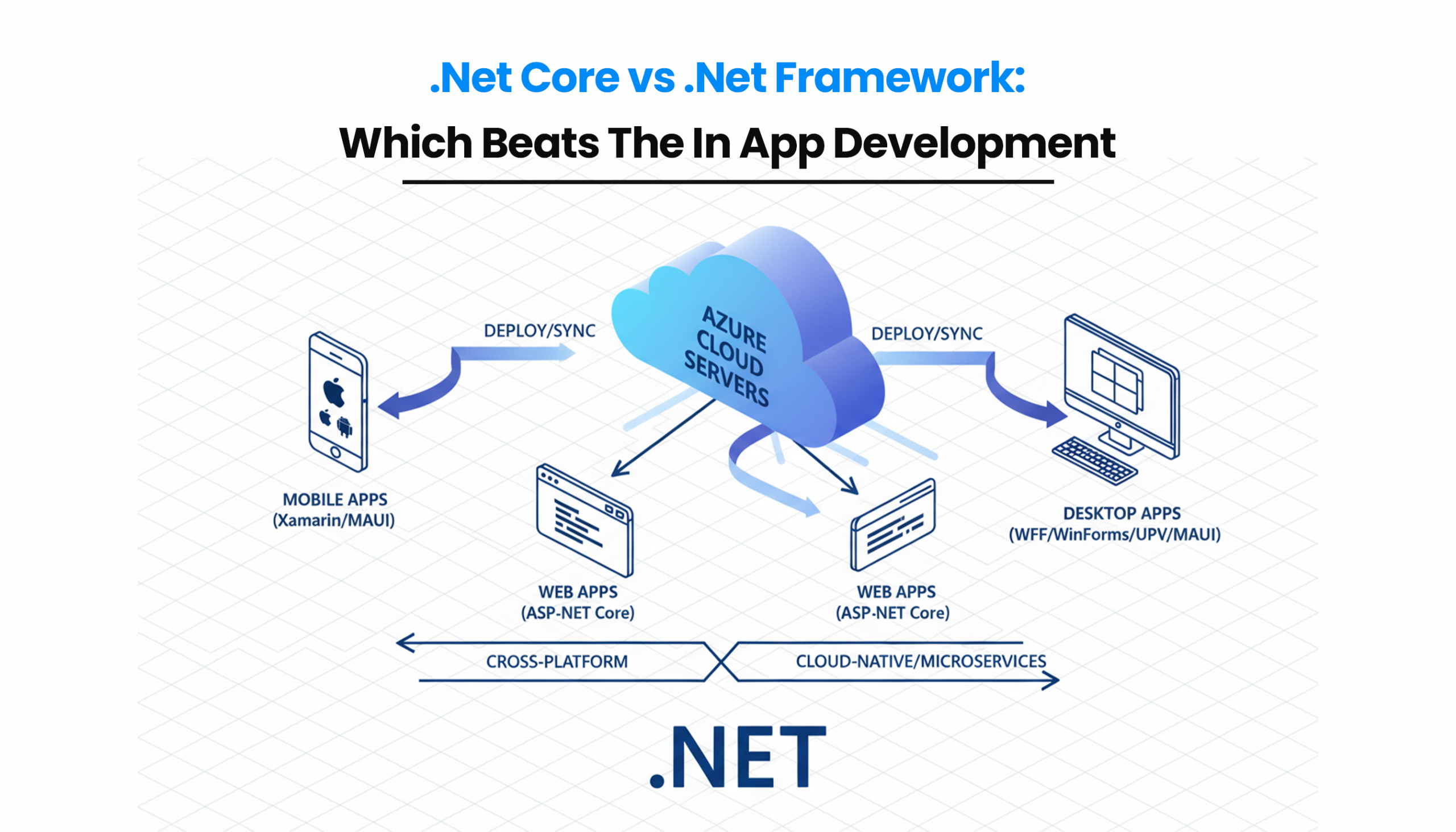
With Microsoft’s evolution of the .NET ecosystem, developers and organizations face an important choice: .NET Core vs the .NET Framework. Both platforms enable developers to build powerful applications, but their strengths, use cases, and future outlooks differ significantly. Choosing the right one can impact performance, development speed, cross-platform support, and long-term maintainability.
This guide explains the differences between .NET Core and .NET Framework, compares key features, and helps you decide which one makes sense for your next project.
What Is .NET Framework?
The .NET Framework is Microsoft’s original implementation of the .NET platform. Released in the early 2000s, it powers traditional Windows applications and relies heavily on the Windows operating system. Over time, it became a staple for enterprise applications, desktop systems, and ASP.NET web apps.
Key characteristics of .NET Framework include:
- Windows only — it runs exclusively on Microsoft Windows.
- Mature and stable — decades of development, updates, and third-party libraries.
- Rich ecosystem — deep integration with legacy Windows APIs, COM, and older enterprise systems.
Despite being reliable and battle tested, .NET Framework is not being actively developed for cross-platform scenarios and Microsoft has shifted its innovation focus toward the unified .NET platform (starting with .NET Core and evolving into .NET 5/6/7+).
What Is .NET Core (Modern .NET)?
.NET Core, now part of the unified .NET platform, is Microsoft’s cross-platform, high-performance, open-source evolution of the traditional .NET Framework. Starting with .NET Core 1.0 and transitioning to .NET 5 and beyond, this stack aims to replace the older .NET Framework for most modern development needs.
Key strengths of .NET Core / .NET 5+ include:
- Cross-platform support: Windows, macOS, and Linux
- High performance: Optimized for speed and scalability
- Modular architecture: Smaller deployments through NuGet packages
- Active development: New features, APIs, and performance improvements each release
- Microservices support: Ideal for cloud, containers (Docker), and distributed systems
This evolution reflects Microsoft’s strategic goal: one unified .NET platform that works across devices, workloads, and environments while reducing fragmentation.
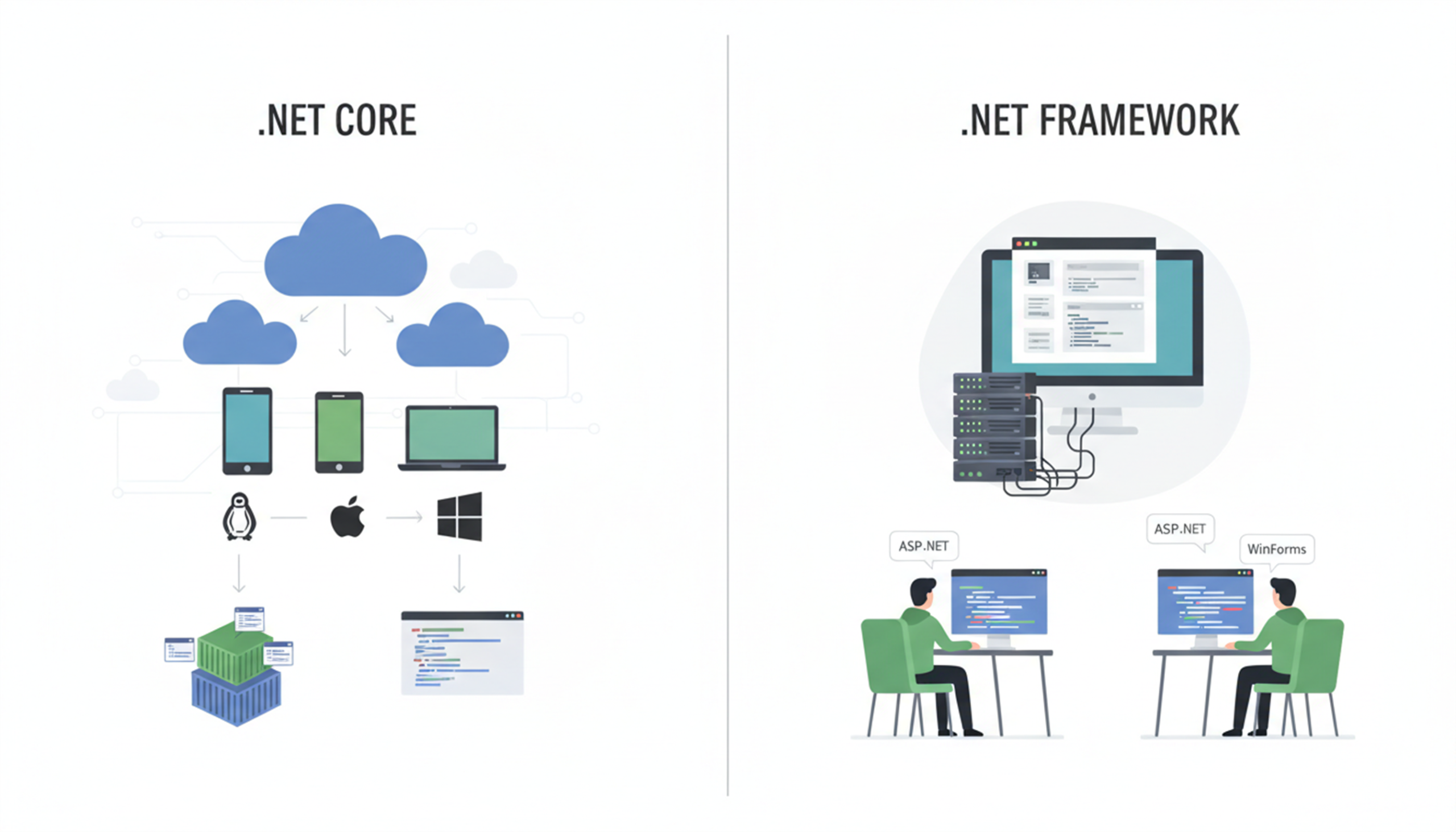
Key Differences: .NET Core vs .NET Framework
Understanding how these platforms compare helps you make an informed choice:
1. Platform Support
- .NET Framework: Windows only
- .NET Core / .NET 5+: Cross-platform (Windows, macOS, Linux)
This makes .NET Core far more flexible for modern development, especially for cloud and container use cases.
2. Performance
.NET Core has been architected for speed. Benchmarks consistently show that APIs, web servers (Kestrel), and asynchronous patterns run faster than their .NET Framework equivalents, a major benefit for high-traffic web applications.
3. Deployment Model
.NET Core supports side-by-side installations, meaning multiple versions can coexist on the same machine. .NET Framework installations, on the other hand, are global and version-locked, which can lead to compatibility constraints.
4. Ecosystem and Modern Features
.NET Core includes modern APIs and productivity features like:
- Span<T>, async streams
- Better dependency injection support
- Improved tooling with .NET CLI
Many new libraries target .NET Core first, reflecting its forward momentum.
5. Development Focus
Microsoft’s roadmap centers on the unified .NET platform (i.e., .NET 6, .NET 7, .NET 8+). Although .NET Framework will continue receiving minor updates, most innovation — including performance enhancements, cloud integration and language features is happening in the .NET Core lineage.
When Should You Use .NET Framework?
Despite .NET Core’s advantages, the .NET Framework still has valid use cases:
Existing Enterprise Apps
Organizations with large, legacy applications, especially those tied to Windows-only features like WCF, AppDomains, or Windows Forms, often continue on .NET Framework because porting would be costly or impractical.
Windows-Specific Integrations
If your application depends heavily on Windows APIs, COM interoperability, or .NET technologies that aren’t fully supported on .NET Core, the .NET Framework remains relevant.
When Should You Choose .NET Core / Modern .NET?
Cloud-Native and Web Apps
If your app targets cloud platforms (Azure, AWS), containers (Docker), or Kubernetes, .NET Core (and its successors) offers cross-platform deployment, performance, and scalability.
Microservices and APIs
Modern web services benefit from the modular design and lightweight deployments made possible by .NET Core.
New Projects
For any greenfield development, whether web, mobile backend, APIs, or cross-platform services, the current .NET platform is generally the better long-term choice.
Migrating From .NET Framework to .NET Core
Many organizations are moving legacy applications to .NET Core to unlock performance, cross-platform support, and future flexibility. Typical migration steps include:
- Inventory Dependencies: Identify which libraries and components are compatible with .NET Core.
- Port Code in Phases: Start with backend logic and services, then UI layers.
- Testing & Validation: Ensure behavior remains consistent after porting.
- Leverage Modern Tooling: Use .NET CLI, template packs, and container workflows to improve efficiency.
Migration requires planning, but the long-term benefits, including improved performance and reduced lock-in, often outweigh the upfront effort.
Real-World Use Cases
Modern Web APIs
Developers building REST APIs for client applications or microservices architectures often choose .NET Core for its performance and cross-platform capabilities.
Cloud and Serverless
Azure Functions and AWS Lambda both support modern .NET platforms, making serverless architectures easier to adopt.
Cross-Platform Desktop Apps
With frameworks like .NET MAUI, developers can now build single codebase apps that run on Windows, macOS, iOS, and Android.
High-Performance Services
Back-end services, event processing, and real-time applications benefit from the performance gains in .NET Core’s runtime and async capabilities.
Conclusion
Here’s a practical way to decide:
- Use .NET Framework if you’re maintaining legacy Windows applications that cannot be easily ported.
- Choose .NET Core (modern .NET) for new development, microservices, cloud workloads, cross-platform apps, and high-performance systems.
In 2025 and beyond, the industry trend is clear: .NET Core and its unified successors are where Microsoft is investing future innovation. Teams that embrace it gain flexibility, scalability, performance, and access to the latest libraries and tooling.